Purposeful Discernment: Making Choices that Feel Right
By Braddon Damien White
This reflection is the second in a four-part series exploring the Four Pillars of Navigation — the orientations through which Transient Harmony invites us to move with greater awareness through the terrain of a life. We continue with Purposeful Discernment. If you missed last week’s reflection on Adaptive Alignment, click here.
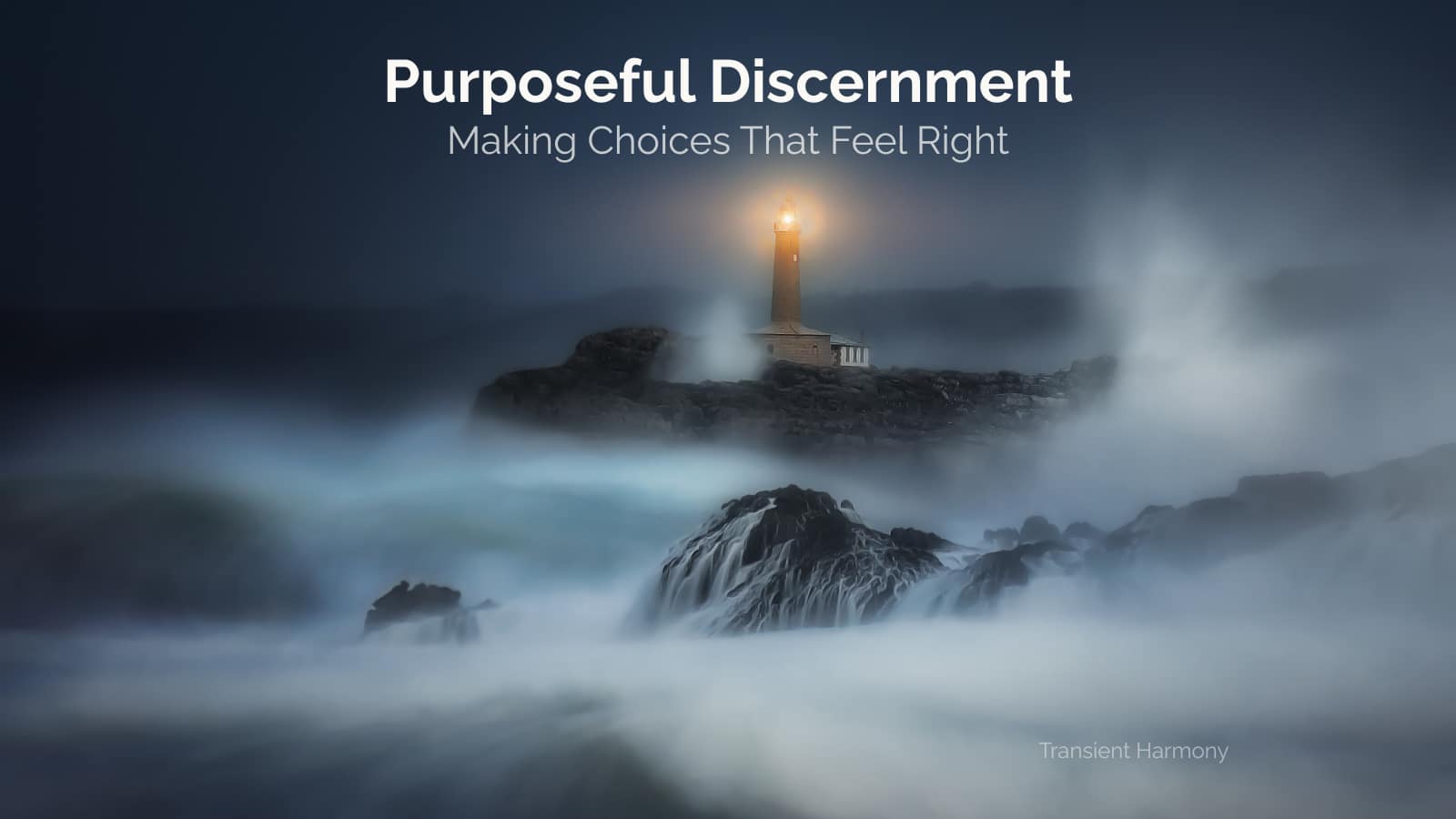
Consider what a lighthouse actually does.
It stands on a rugged coastline in the middle of a storm — waves crashing against the rocks, winds howling, the sea churned into chaos. The lighthouse makes no attempt to calm the water. It doesn’t push back the tide or silence the wind. To do so would be beside the point entirely.
Instead, it does one thing: it sends a steady beam of light into the darkness. That light doesn’t change the conditions. But it transforms the navigator’s relationship with them. It reveals the safe channel from the hidden reefs. It provides a fixed point of orientation when everything else is in motion. For the sailor straining to see through the storm, the appearance of that beam doesn’t end the danger — but it restores something essential. It makes navigation possible again.
We know this feeling. Not from actual lighthouses, but from the inner version of that same clarity. The moment when, in the middle of overwhelming noise — obligations, expectations, competing demands, our own emotional weather — something steadies. Not because the circumstances changed. But because we found, or returned to, a fixed point. We remembered what actually matters. And from that remembering, we could move again.
This is Purposeful Discernment. Not the elimination of chaos, but the cultivation of an inner light steady enough to navigate by.
What this pillar produces, when practiced honestly, is integrity. Not in the narrow sense of honesty, but in its fuller meaning: wholeness. The alignment of inner values with outer choices. When discernment matures into integrity, we begin to act from clarity rather than compulsion — not because we’ve gathered enough certainty, but because we’ve learned to recognize our own signal.
Most of us were taught that clarity is something you build toward. You gather more information. You consult more people. You weigh more options. And eventually — if you’ve been thorough enough — certainty arrives and the right answer becomes obvious. There is something worth honoring in that rigor.
But there is a version of this that quietly becomes paralysis — or outsourcing. We keep gathering, keep consulting, keep waiting for the storm to quiet enough that the path reveals itself. We hand our inner compass to whoever seems most confident, most credentialed, most certain. And we call that wisdom. Often, it is deference wearing discernment’s clothing.
There is a subtler form of outsourcing still. We don’t just hand others our decisions — we hand them our desires. We inherit scripts about what a successful life looks like, what a responsible person prioritizes, what a good choice resembles. These expectations arrive so early, and settle so quietly, that they begin to feel like our own values. Purposeful Discernment asks the uncomfortable question that cuts beneath all of that: Is this what I actually value — or is this what I’ve learned to want? Living by values creates decisions that nourish. Living by expectations creates decisions that deplete. The difference is not always obvious from the inside. That is precisely why discernment is a practice.
What the pillar asks of us is not the accumulation of certainty, but the cultivation of clarity. And clarity, in this framework, is not found in knowing everything. It is found in knowing what truly matters.
In practice, the pillar moves through three orientations — not as a sequence, but as a vocabulary for navigating from the inside out.
What is mine to carry. There are things that genuinely belong to us — responsibilities, choices, relationships that are ours to hold. Discernment begins here, with the honest identification of what actually belongs to us in a given moment. Not what we feel pressured to carry. Not what we have habitually assumed was ours. But what, when we grow quiet enough to sense it, genuinely belongs in our arms.
What is mine to shape. Within what we carry, there is a further distinction — between what we can genuinely influence and what lies outside our reach. This is where so much unnecessary suffering lives. We pour enormous energy into bending other people’s choices, managing outcomes that depend on factors beyond us, holding tightly to conditions that are already moving. Discernment shines its light here too: this is mine to shape. That is not. When we live from this clarity, something releases.
What is not mine to hold. Not everything that arrives at our door belongs there. Not every obligation, expectation, or emotional weather system that lands in our vicinity is ours to manage. Part of the practice is the honest, sometimes uncomfortable act of setting down what isn’t ours — not with neglect, but with the quiet firmness of someone who has learned that scattered energy serves no one well.
But the ego knows this vocabulary too, and it will use it in its own service. It decides something is “not mine to carry” when it simply doesn’t want to deal with it. It frames avoidance as discernment. It declares things beyond its influence when the truth is they’re frightening, and stepping back feels safer than engaging. It sets down what it should be holding, and holds fast to what it should have released long ago.
There is also a distortion that moves in the opposite direction. Under-discernment scatters us — we say yes to everything, spread ourselves thin, depleted by obligations that were never ours to carry. But over-discernment calcifies us. We become so guarded about what we allow in that we close off possibility alongside noise. We decline before we’ve truly listened. We protect ourselves from distraction so fiercely that we also protect ourselves from growth, from surprise, from the unexpected invitation that might have changed something essential. Purposeful Discernment holds both errors in view.
This is why the pillar requires awareness as its ground. The pillar is a lens. Awareness is the eye that looks through it. Without that deeper listening, discernment becomes sophisticated rationalization. With it, it becomes genuine navigation.
One practice that helps: learning the difference between reaction and response. A reaction arises from habit, fear, the conditioned self moving faster than awareness can follow — snapping in frustration, grasping to fix what isn’t ours to fix, saying yes before we’ve paused to feel whether this actually belongs to us. A response arises in the space that opens when we pause, even briefly. In that space, something more honest can speak. The question isn’t what do I feel urgently right now? It is what do I actually know, when the urgency quiets?
There was a season in my life when I said yes to nearly everything — every project, every obligation, every social commitment that came my way — not because any of it resonated, but because I was afraid of what saying no might mean. From the outside, it looked like generosity, even ambition. Inside, it felt like slow erosion. Every yes to something misaligned was a quiet no to what actually mattered. It took months of depletion before I was willing to ask the essential question: Is this mine to carry? And to sit with it long enough to hear something honest in return.
What I eventually found was simpler than I expected. The things that nourished me, once I cleared the noise, were the things I had actually chosen — not the things I had accepted out of fear of disappointing someone. Living by my values and living by others’ expectations had felt identical for so long that I had stopped noticing the difference. Discernment gave me back that distinction.
The lighthouse doesn’t calm the waves or silence the storm. Its strength is clarity — the steady beam that reveals what matters most when everything else rages.
Purposeful Discernment offers us the same. It doesn’t promise ease. It doesn’t remove the noise of a life fully lived. What it offers is a fixed point: an inner light steady enough to navigate by, and a growing capacity to know — even in the middle of the storm — what is yours to hold, and what was never yours to carry at all.
Clarity is not found in knowing everything. It is found in knowing what truly matters.
Living the Question
- Where in your life are you pouring energy into what you cannot influence — and what might open if you redirected that energy toward what is genuinely yours to shape?
- When you face a choice, can you sense whether you are living from your own values — or from someone else’s expectations of who you should be?
- What is one thing you are currently carrying that may not actually belong to you — and what would it feel like to honestly set it down?