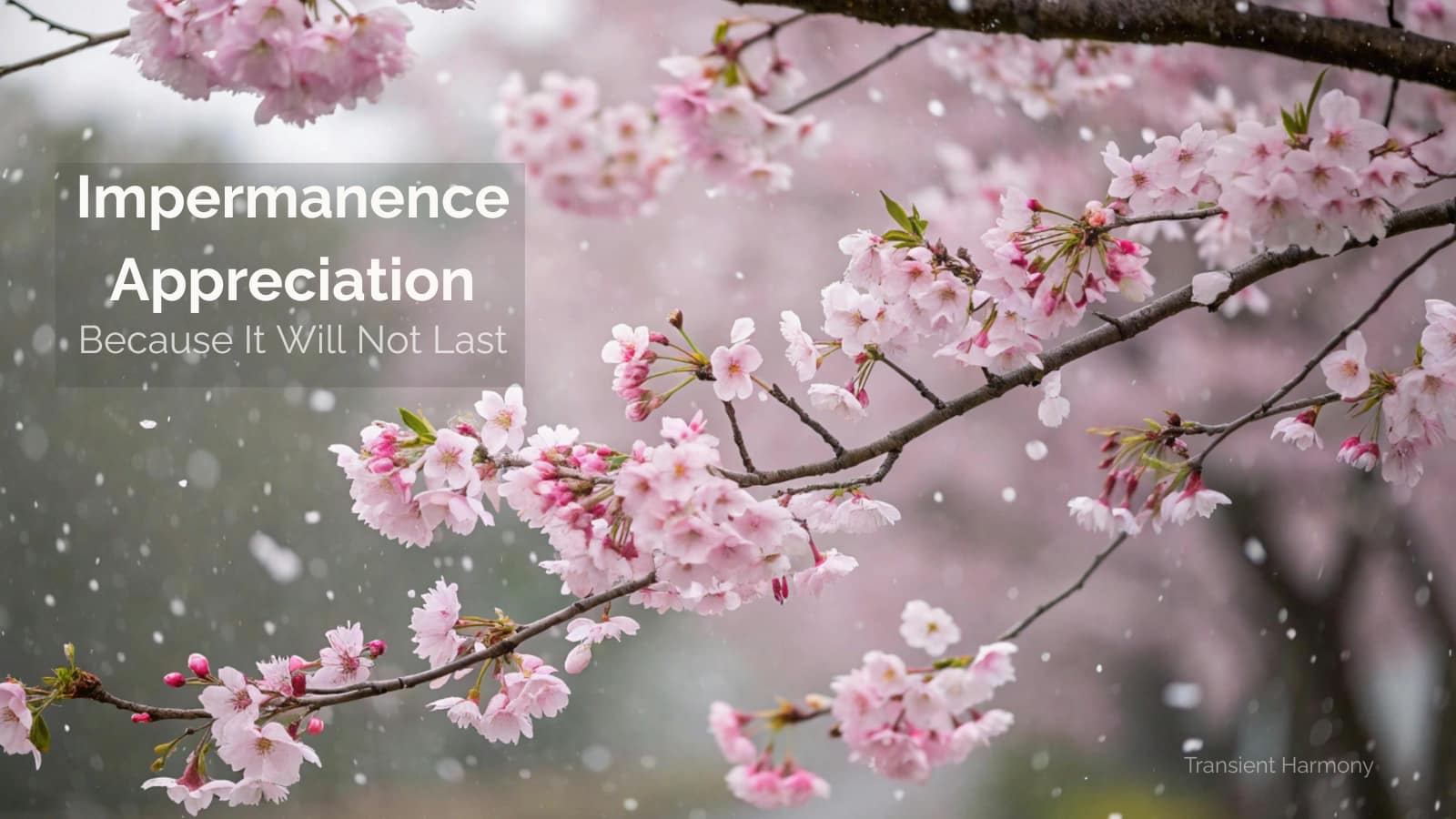
Impermanence Appreciation: Because It Will Not Last
By Braddon Damien White
This reflection is part of a four-part series exploring the Four Pillars of Navigation — the guiding practices at the heart of Transient Harmony. If you’re joining mid-journey, the series began with an introduction to all four pillars, followed by individual essays on Adaptive Alignment and Purposeful Discernment. Each pillar stands on its own, though together they form a single compass.
Anyone who has loved a pet knows something particular about impermanence — something that sneaks up on you in the quietest moments.
You are sitting on the floor, or they are curled against your leg, and without ceremony, you are aware: this will not always be. Their years are shorter than yours. You entered this relationship knowing that. You stayed anyway. You stayed more fiercely.
What I keep returning to is that this awareness doesn’t diminish the love. It deepens it. The morning greeting at the door carries more weight because I know there will be a morning when it doesn’t come. The warmth of a body nearby matters more than it would if I believed it would always be there. I am more present to what is here because I know it is temporary.
This is what Impermanence Appreciation is pointing toward. Not grief. Not resignation. Something more alive than either: the recognition that limitation is not the thief of meaning — it is its source.
There is a practice in certain Buddhist traditions worth sitting with. Monks spend days, sometimes weeks, creating a sand mandala — an intricate, breathtaking pattern of colored sand. The work demands immense focus and devotion. When it is complete, they sweep it away. The sand is poured into a river.
To an outside observer, this looks like loss. But the monks understand it differently. The sweeping is not destruction. It is completion. And the beauty of the mandala — what makes it worth the weeks of labor — is inseparable from its impermanence. A permanent mandala would be something else entirely. It would be furniture. What makes it sacred is precisely that it is released.
This is the paradox at the heart of this pillar: things are not beautiful in spite of their passing. They are beautiful because of it.
The cherry blossom is celebrated not for its longevity but for its brevity. A piece of music moves us because it unfolds in time and then falls into silence — the note’s beauty exists in its disappearance as much as its sounding. A sunset earns its power from the knowledge that in minutes it will be gone. If these things lasted forever, they would become wallpaper. It is their transience that calls us awake.
Here is where Transient Harmony offers something I don’t think I’ve seen said quite this clearly elsewhere.
Within this framework, the celestial soul exists in wholeness. It exists in relational richness, in something that might be called structural understanding — a knowing that doesn’t require sequence or limitation to access. But there is one thing the celestial soul cannot experience from within the celestial realm.
Limitation itself.
It can understand grief conceptually. It cannot feel the specific weight of watching something it loves slip away. It can know what endings are. It cannot taste the texture of a final conversation, a last morning, a door that no longer opens. That requires a body. A clock. An ending.
This is part of why the soul chooses mortal life.
Not as punishment. Not as exile. As texture — the one quality that the eternal, unlimited celestial realm cannot generate on its own. Impermanence is not a flaw in the design of incarnation. It is the design. We came here, in part, because this is the only place where things end. And endings are what make presence possible.
When I understood this, the sand mandala stopped looking like a lesson in letting go. It started looking like the entire point.
Impermanence Appreciation, as a pillar practice, is the art of releasing with gratitude — embracing change, transience, and endings as necessary rhythms of growth and renewal. That framing matters. It is not passive acceptance. It is not making peace with loss by convincing yourself it doesn’t hurt. It is the active, ongoing practice of staying present to what is here, knowing it is temporary, and letting that knowledge deepen your engagement rather than diminish it.
But like every pillar, awareness must be doing the discerning. The ego can reach for this one in ways that look like wisdom and are something else entirely.
The most seductive misuse is spiritual bypassing — invoking impermanence to skip the depth of what impermanence is actually asking you to feel. Grief arrives and the ego reaches for the philosophy: it passes, nothing lasts, I shouldn’t cling. The insight gets used to avoid the experience the insight requires. You invoke the lesson to stay safely above the water, when the pillar is asking you to go in.
A second misuse slides into nihilism. If nothing lasts, why invest? Why commit, build, love without reservation? The ego translates things are temporary into things are therefore weightless. But the pillar is not an argument for withdrawal. It is a call toward more wholehearted engagement — perhaps the most wholehearted available to us.
There is a subtler misuse too: anxious grasping dressed as appreciation. Hyperawareness of impermanence can tip into trying to capture and preserve everything — photographing rather than experiencing, cataloguing rather than feeling. The fear of loss masquerades as presence. You are in the moment but not quite with it.
And perhaps the most common misuse in relational life: offering this pillar to someone in pain before they have been fully heard. Everything changes. It will pass. Let it go. Offered too quickly, these truths close down the very depth impermanence is meant to honor. The pillar is not a tool for shortening other people’s sorrow.
The practice, at its core, is quieter than any of these distortions.
It is noticing the morning greeting while it is still here. Letting a meal with people you love be what it is without rushing it or documenting it. Allowing grief to move through you with the same trust you extend to joy — knowing it is not permanent, and that its impermanence doesn’t diminish its truth. Holding your life, and everything in it, with an open hand.
My pets have been my most consistent teachers of this. Not because they are symbols of loss, but because they make presence unavoidable. Their time with us is short enough that we cannot afford to be absent for it.
I think the celestial soul understood this perfectly when it chose to come here.
Limitation is not what we endure in mortal life. It is what we came for.
Every moment is precious precisely because it will not last.
Living the Question
- Where in your life are you moving through something rather than being present to it?
- What are you appreciating more deeply because you know it won’t last?
- Is there a grief you’ve tried to manage with philosophy, when what it needed was simply to be felt?