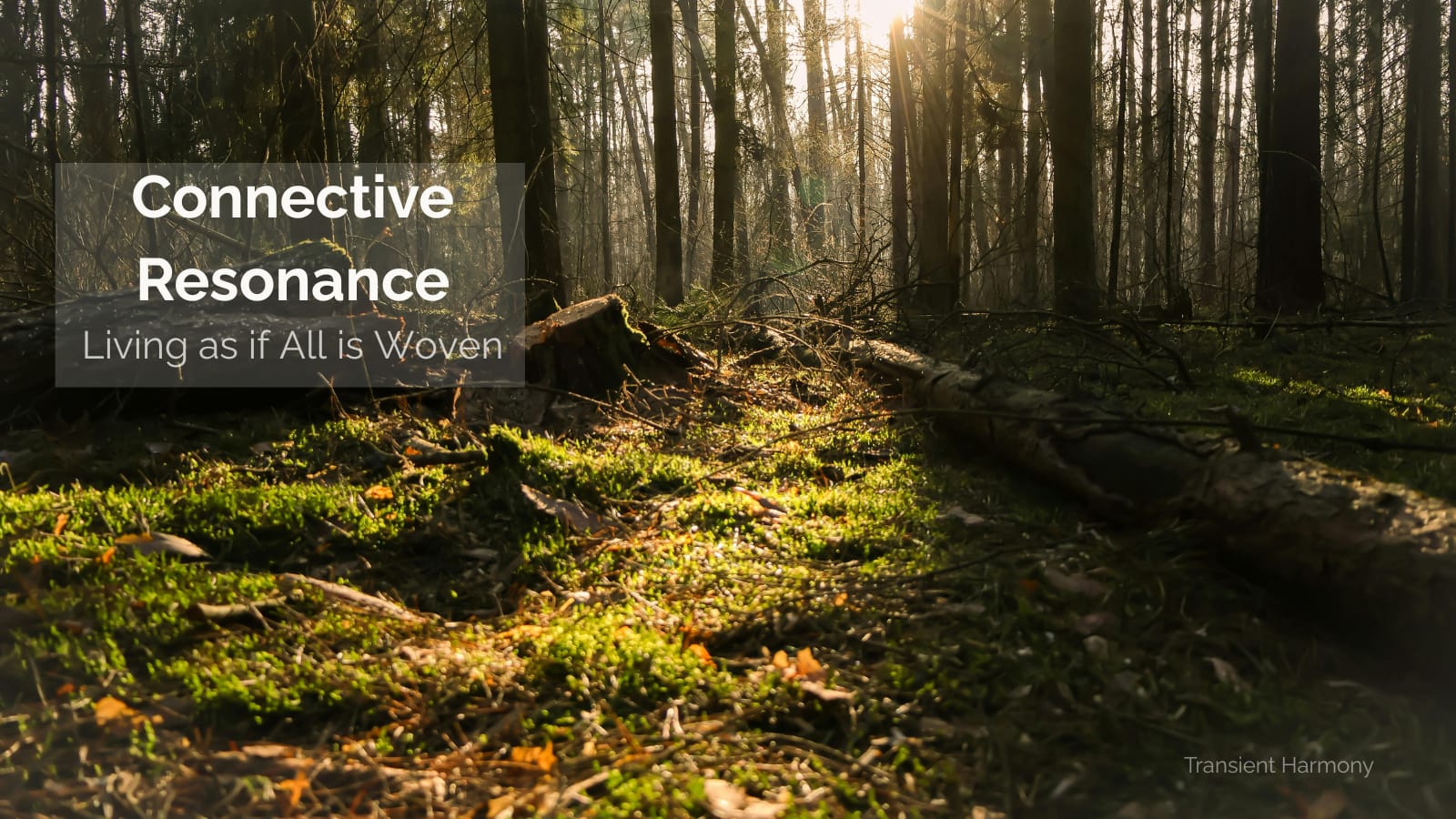
Connective Resonance: Living as if All is Woven
By Braddon Damien White
This reflection is the fourth in a series exploring the Four Pillars of Navigation — the practical orientations at the heart of Transient Harmony. If you’re arriving here for the first time, you might find it useful to begin with Understanding the Four Pillars: Your Compass for the Journey.
When we walk through a forest, we see trees. Individual ones. A pine here, a birch there, each standing apart, their canopies competing in silence for the same thin band of light. From the surface, the forest appears to be a collection of separate lives — each rooted in its own patch of ground, each managing its own survival.
But beneath the forest floor, something else entirely is happening.
Hidden from sight is one of the most remarkable systems in the natural world: a vast network of fungal threads called mycelium, woven through the soil in every direction. Through this network, trees communicate. A towering mother tree, rich in sunlight, sends nutrients down through her roots and across the threads to a struggling sapling shaded in the understory. When one tree comes under attack from insects, chemical signals travel through the network, and neighboring trees begin raising their defenses before the threat ever arrives.
The forest is not a collection of individuals managing their own survival.
It is a community — sustained, nourished, and made resilient by a web of connection that cannot be seen from where we are standing.
This is what Connective Resonance asks us to consider: that the story we tell about separation may be just as incomplete as the story we tell about trees.
We navigate our lives much the way we walk through a forest — noticing the individual shapes, the distinct personalities, the separate concerns. We define ourselves by what sets us apart: our particular history, our private struggles, our unique perspective. And there is truth in that. We are distinct. No two lives are alike, no two souls carry the same resonance.
But beneath that surface of apparent separation lies something the mycelium makes visible in miniature: a field of connection so fundamental it cannot be an accident. It is the medium through which empathy travels — the reason a stranger’s grief can land in your chest before you’ve even registered the logic of it. It is what stirs when you feel an instant recognition with someone you’ve just met, or when the presence of another person in a difficult moment shifts something that words could not reach. These are not small coincidences. They are the network making itself known.
Connective Resonance is the practice of attuning ourselves to this reality. Not manufacturing connection, but noticing the one already present. It is the shift from experiencing life as a solitary passage to recognizing it as a shared journey — one in which our soul strings intertwine through the same invisible field that threads root to root beneath the forest floor.
Here is what the mycelium teaches that the trees, from their individual vantage, cannot see: difference is not what prevents the network from functioning. Difference is what makes it work.
The pine and the birch do not need to be the same species to be woven together. The sapling and the mother tree do not need to be equal in stature to sustain one another. It is precisely their differences — their distinct relationships to light, to soil, to season — that make the exchange between them meaningful. A network of identical trees, drawing on identical resources, would have far less to offer one another.
We are similarly unique in this way. The common ground between us is not sameness. It is the fact of our distinctness itself — that every one of us is irreducibly particular, and that this particularity is exactly what we have to offer the shared field. Our individuality is not a barrier to belonging. It is the condition for it.
This is what the pillar means when it names resonance rather than uniformity. Resonance is not the sound of everyone playing the same note. It is what happens when different notes, played with presence and attention to one another, find their way into harmony. The music only exists in the space between.
Connective Resonance, like the other pillars, follows a movement from perspective to virtue to practice.
The perspective is simply this: no being, no experience, exists in isolation. Our choices ripple outward in ways we cannot always trace. The smallest act of presence — a moment of genuine listening, a word offered without expectation — reverberates through the web of being further than we will ever know.
From that perspective grows the virtue of compassion. Not pity, which looks across a distance, but the deeper recognition that another’s struggle is not separate from our own. When we feel something in the presence of another person’s grief or joy, we are not imagining it. We are feeling the threads move. Compassion is not an achievement. It is what awareness naturally does when it stops pretending the separation is real.
And from compassion, practice becomes possible. Presence — offering full attention without rushing to fix or respond. Curiosity — approaching difference as an invitation rather than a threat, asking what truth might be available here that our own vantage cannot reach. Contribution — recognizing that our flourishing and others’ flourishing are not in competition but woven together, so that lifting someone else is not self-sacrifice but participation in the network’s health. And receiving — allowing ourselves to be supported in return, because resonance is never one-directional. The tree that only sends and never draws is not a healthier tree. It is a dying one.
The pillar also names a distortion worth recognizing. Too little connection isolates us, and isolation always narrows. But too much connection without the clarity of our own distinct voice dissolves us. True resonance does not erase the individual tree — it amplifies it within the forest. The goal is not merger but harmony: knowing where we end and another begins, and choosing to remain in relationship across that distinction.
If Adaptive Alignment teaches us to flow, Purposeful Discernment teaches us to focus, and Impermanence Appreciation teaches us to savor — then Connective Resonance teaches us to belong. Not by becoming less ourselves. But by discovering that who we are becomes most fully visible in the mirror of genuine relationship.
Beneath the forest floor, the mycelium threads carry what the trees cannot carry alone. And in that quiet, invisible exchange — root to root, life to life — the forest becomes something none of the trees could be on their own.
We are not solitary trees managing our survival.
We are the forest.
Living the Question
- Where in your life are you navigating as if you are separate — and what might shift if you allowed the network to be real?
- When difference shows up in your relationships, do you tend toward curiosity or toward judgment? What would it take to approach it as the pine approaches the birch — as something the network needs?
- Where are you giving freely but struggling to receive? What would it mean to let the exchange move in both directions?