Adaptive Alignment: Staying True While the Terrain Changes
By Braddon Damien White
This reflection is the first in a four-part series exploring the Four Pillars of Navigation — the orientations through which Transient Harmony invites us to move with greater awareness through the terrain of a life. We begin with Adaptive Alignment. If you missed the intro essay to the four pillars, click here to read it.
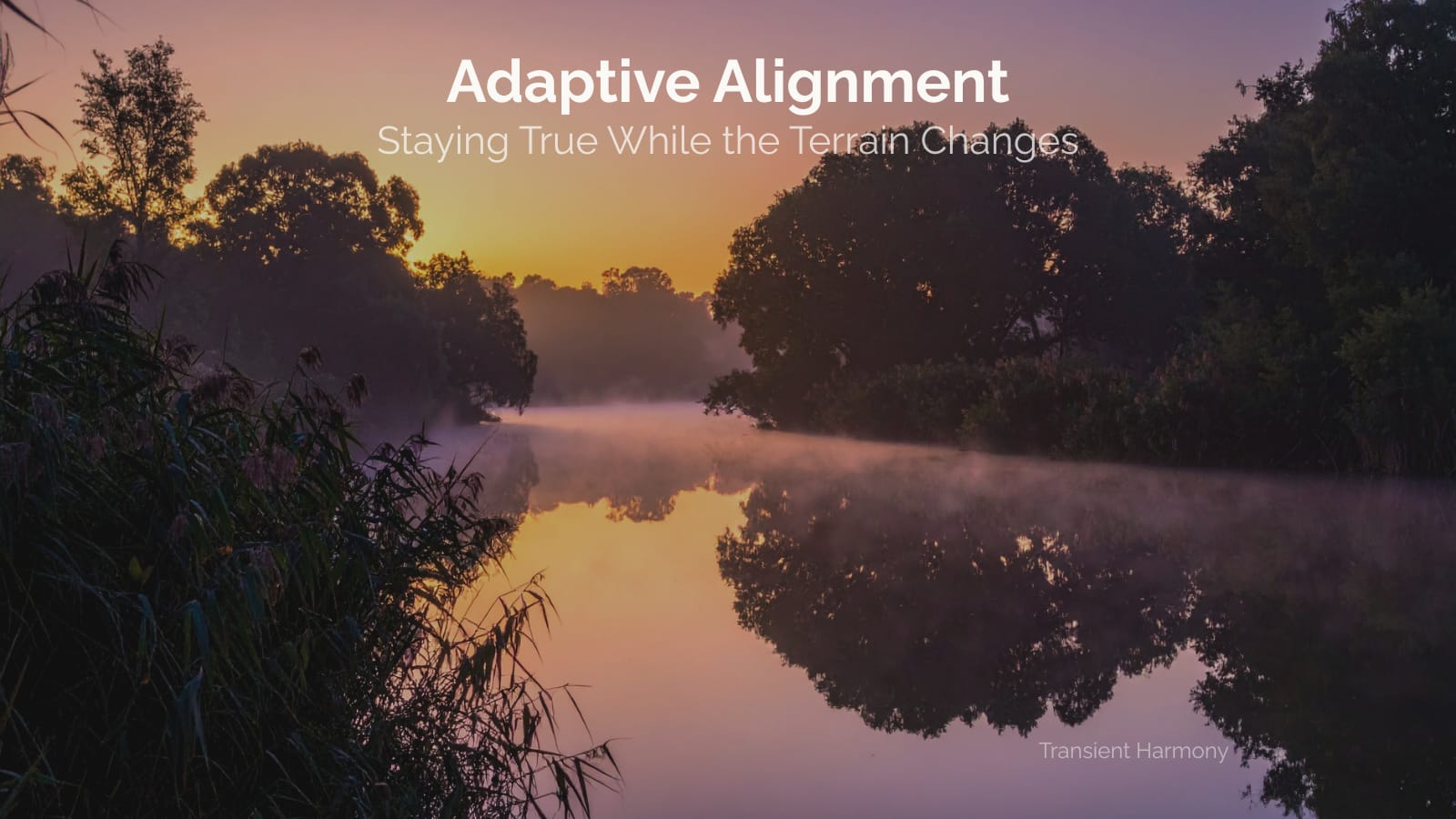
Consider what a river actually does.
When it meets a boulder, it doesn’t stop being a river. It doesn’t shatter itself against the stone, and it doesn’t give up its direction. It finds another way to move — around, over, gradually through — and it continues toward the sea. What changes is the path. What never changes is what the river is.
This is the image at the heart of Adaptive Alignment. Not letting go. Not surrender. Not going limp in the face of whatever comes. It is the capacity to stay entirely yourself — to hold the thread of your deeper purpose — while remaining supple enough to move with the terrain rather than break against it.
Most of us were taught a particular idea of strength. It looked like persistence. Like not quitting. Like the one who kept going regardless of what the circumstances were asking. And there is something true in that — commitment matters, and the willingness to stay with something difficult is worth developing. But there is a version of persistence that stops serving the journey and starts serving only the ego’s need to prove it was right. A hammer strikes the same surface again and again, convinced that force alone will eventually produce change. It exhausts itself. And it often leaves more damage than it intended.
Adaptive Alignment is the third thing — neither the hammer nor the drift. It is active, awake, and ethically grounded. We choose how to meet each situation in a way that serves both the moment and the longer purpose we are carrying.
The bamboo tells a version of the same story. When a storm moves through, bamboo bends — fully, dramatically — and then returns to upright when the wind passes. Its resilience lies not in resistance but in that quality of bending without breaking, yielding without surrendering its shape. Rigidity would snap it. Pure drift would leave it horizontal, tangled in itself. The bamboo’s particular genius is that it remains, through the storm, entirely bamboo.
In practice, Adaptive Alignment asks us to move among three orientations — not as a formula, but as a vocabulary for discernment. Yielding, when the boulder truly will not move and flowing around it preserves both energy and direction. Holding, when conditions are unclear and the wisest thing is to let the silt settle before the channel becomes visible. Advancing, when the current is with us and steady forward movement is what serves.
But knowing the three modes and navigating them well are different things. The ego knows this vocabulary too — and it will use it in its own service. It yields when it wants to avoid a difficult conversation and calls that flow. It advances when it wants to prove it was right and calls that purpose. It holds when it’s afraid to move and calls that wisdom. This is why the pillars of navigation are not tools of the mind alone. They require something deeper to guide them — the awareness we explored in earlier reflections, the kind that listens below the surface of what we want to believe is happening. Awareness is what allows us to ask honestly: Is this yielding, or is this avoidance? Is this advancing, or is this ego? Without that deeper listening, the pillar becomes sophisticated justification. With it, it becomes genuine navigation.
The art is in reading which the moment is actually calling for. And this is where most of us lose our footing — not because we don’t understand the principle, but because the three modes are easy to confuse.
We tell ourselves we are yielding when we are actually avoiding. Going with the flow, we say, when in truth we are postponing the conversation we know we need to have, delaying the step we know is next. What looks like alignment is drift — direction quietly abandoned, purpose slowly diffusing. True yielding carries alertness. It knows what it is doing and why.
We tell ourselves we are advancing when we are actually forcing. We push harder, hold on longer, convince ourselves that effort alone proves commitment. But the signals gather: doors quietly closing, energy draining, the sense that something is straining beyond its tolerance. What we mistake for strength is often resistance to what life is already trying to teach us. The wiser move is to pause, return to purpose, and ask whether what we are doing still serves it — or whether we are simply unwilling to adjust.
And we tell ourselves we are holding — waiting wisely — when we are actually hiding. Waiting for the right moment can conceal fear, especially when months pass without new clarity arriving. True holding is observant. It remains in contact with the situation, alert for signals. When stillness becomes hiding, the correction is a small step — something reversible, something that generates feedback and re-engages the current.
I have made all of these mistakes. There was a season when I stayed in a role long past its natural end, certain that more effort would eventually produce the outcome I had decided it was supposed to have. The signs were everywhere. I ignored them. What I called commitment was really a refusal to let the situation be what it had already become. I burned out trying to force what wasn’t going to yield. Later, in a different transition, I finally chose to stop pushing against what wasn’t working. I waited — genuinely waited, with attention — and when the path opened, it aligned more naturally than anything I could have manufactured through sheer determination. The relief wasn’t just physical. It felt like finally moving with the current rather than across it.
Adaptive Alignment doesn’t hand us a formula. It teaches us to sense, to feel, to adjust — and to trust that staying true to what matters doesn’t require us to force the shape of how it arrives.
The river reaches the sea. Not because it overpowered every stone in its path. Because it never stopped moving, and it never stopped being a river.
Life is not won by force but by flow.
Living the Question
- Where in your life are you acting more like a hammer than a river — striking the same surface, convinced that more force will eventually produce something different?
- When you feel resistance in a situation, can you sense whether it is calling for yielding, holding, or advancing — and what in you makes one of those harder to choose?
- What would it mean to stay entirely true to your deeper purpose while releasing your grip on exactly how it must arrive?