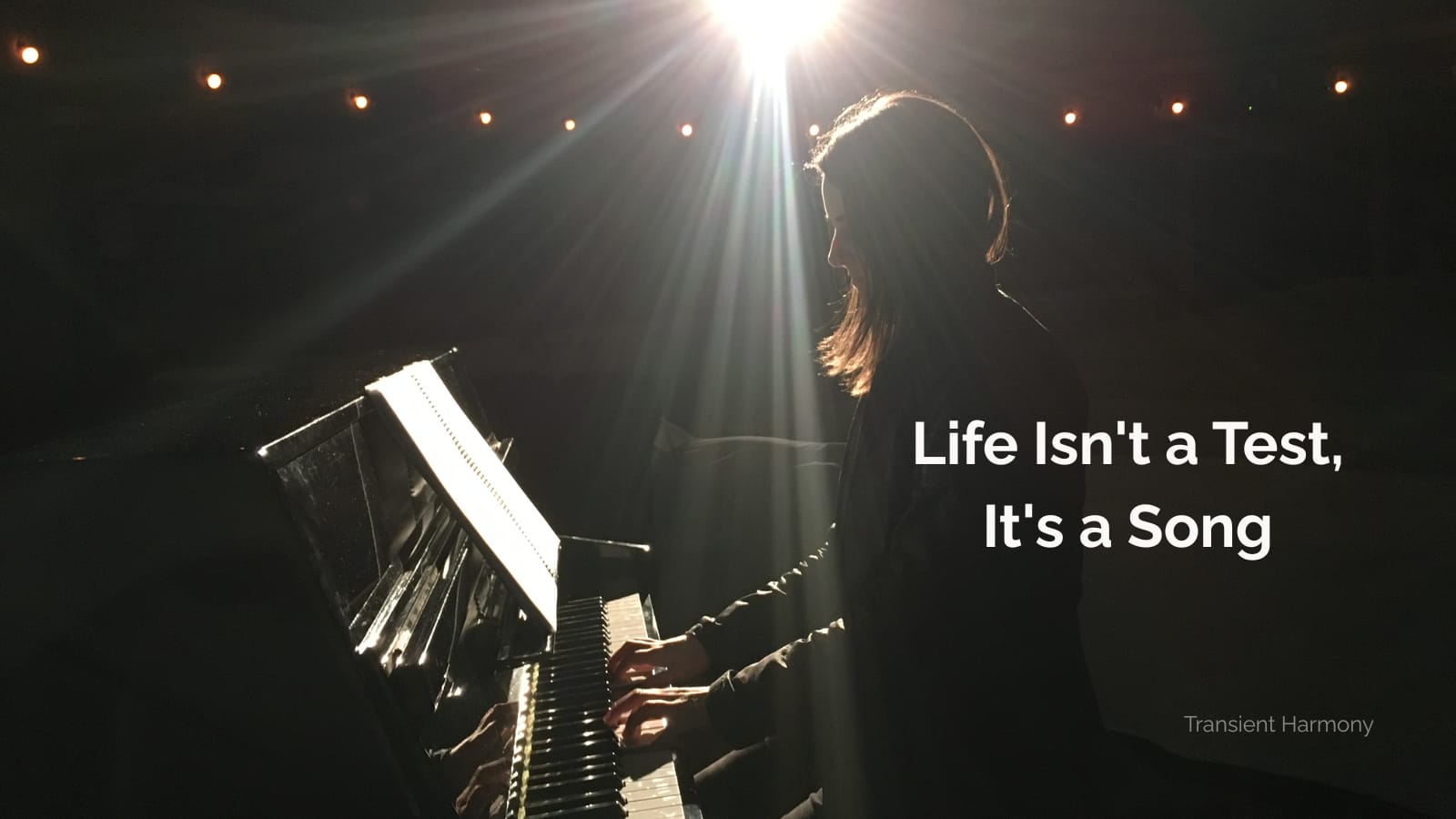
Life Isn’t a Test, It’s a Song
By Braddon Damien White
Many of us were handed a framework in which life is fundamentally a test.
Not always in those exact words. But the structure is unmistakable once you see it. There is a right way to live and a wrong way. There are consequences for failure that extend beyond this life. Someone — or something — is keeping score. And the stakes are permanent.
That framework produces a particular relationship to experience. Watchful. Measuring. Quietly anxious about whether you are getting it right. Even in secular versions of this orientation — where the test is not cosmic but personal, where the scorekeeper is not God but your own relentless self-assessment — the same pressure operates. Life becomes something to perform correctly rather than something to inhabit fully.
What I want to offer here is not a gentler version of that framework.
It is a different one entirely.
In Transient Harmony, the soul does not enter mortal life to be evaluated. It enters to create something.
Before incarnation, the celestial soul selects a mortal life string — not as a script to execute correctly, but as a resonance field. A particular terrain of experience chosen because that terrain, and only that terrain, can generate what this soul came to generate. The choosing is real. The specificity is real. The soul does not stumble into a life. It selects one, with awareness of the arc — the general energetic landscape, the themes and textures and possibilities of this particular human existence.
And then it enters. Fully. Through the Veil of Purposeful Forgetting, into the immersive density of mortal experience.
Not to pass.
To play.
The distinction matters more than it might first appear. A test is something you take. You are the subject; the evaluation is external to you. Your role is to perform correctly against a standard you did not set. But a song is something you play — you are inside it, contributing to it, shaping it through every choice you make. The music does not exist without the player. The player is not incidental to the song. The player is how the song becomes real.
This is what mortal life is, in this framework. Not a performance being graded. A creative act being lived.
And what the soul is creating is not abstract.
Lived experience generates something the Celestial Realm cannot produce through contemplation alone. The texture of grief that only comes from loving someone you could lose. The particular quality of courage that only exists when the outcome is genuinely uncertain. The depth of joy that only lands when it arrives inside a life that also knows sorrow. These are not byproducts of mortal experience. They are its purpose. The soul returns from a mortal life string carrying something it could not have carried any other way — lived texture woven into its eternal being, deepening the resonance of what it is.
Creation, not evaluation. Contribution, not compliance.
But here is the part that matters just as much: the soul chose the terrain. You are navigating it.
Both halves of that are essential.
The soul’s selection of a mortal life string is not the whole story. Within that string, every choice is yours. The improvisations — how you respond to difficulty, what you reach for in uncertainty, what you build from what you were given — these are not predetermined. The terrain is selected. The path through it is lived, in real time, by a mortal self with genuine agency and genuine stakes.
This is not fatalism dressed in spiritual language. It is something closer to the opposite. If life is a test, you are a subject being evaluated. If life is a song, you are a player whose choices shape what the music becomes. The accountability does not diminish. If anything, it deepens — because it is no longer about measuring up to an external standard. It is about what you are actively creating through the living of this particular life.
A player who hits a wrong note has not failed the song.
Music is not destroyed by dissonance. Dissonance is part of composition. What matters is not whether every note lands perfectly but whether the music remains alive — whether the player stays present, keeps moving, finds the next phrase. The great improvisers are not those who never miss. They are those who know how to meet whatever they’ve played and move forward from there.
Mortal life asks something similar of us.
The seasons of difficulty, the notes that don’t land, the passages that feel unresolved — these are not evidence that you are failing the test. They are the density of the terrain the soul chose because only this terrain could produce what this life is here to bring into being.
And underneath all of it — beneath the uncertainty and the improvisation and the accumulated texture of a human life — the soul remains anchored. The Celestial Realm is not a waiting room where the real reckoning happens. It is the ground the soul never left. Mortal life is not a detour from something more important. It is the creative act itself.
The difference between inhabiting life as a test and inhabiting life as a song is not merely philosophical.
It is felt.
The test-taker wakes up measuring. The player wakes up listening — for what the day is offering, for what the terrain is asking, for what this particular passage of the music wants to become.
You are not here to be evaluated.
You are here because your soul chose this exact terrain — this specific constellation of relationships and limitations and possibilities — and what you do inside it is being woven into something that will always have been.
That is not a small thing.
That is the whole point.