The Weight Doesn’t Have to Lift First
By Braddon Damien White
There is a particular kind of exhaustion that sleep cannot reach.
You do everything right. You rest. You eat well. You show up. You move through the days responsibly, sometimes even gracefully. And still you wake up tired. Not physically depleted — something deeper. A heaviness that sits behind the eyes, in the chest, in the quiet space between waking and rising where you take inventory of how you feel and find the same answer as yesterday.
This is not laziness. It is not weakness. It is not a failure of habit or discipline.
It is what happens when the mental and emotional layers of the self have been carrying more than they were designed to carry alone.
Viktor Frankl understood something about this that most of us spend years trying to disprove.
Held in the most brutal terrain imaginable — stripped of freedom, of dignity, of everyone he loved — he discovered that the last human freedom is the freedom to choose how we meet what is in front of us. Not escape it. Not resolve it. Not wait for it to lift. Meet it. And in that meeting, find orientation.
He did not endure Auschwitz by sinking under its weight. He endured by finding meaning inside it. The circumstances did not change. He did.
Most of us will never face what Frankl faced. But many of us know a version of that particular paralysis — the rut that the checklist cannot reach, the season that simply will not turn, the midlife moment when the structures that carried us this far stop feeling load-bearing and we are not sure what holds the weight now.
Transient Harmony does not offer another practice to add to the stack. It does not prescribe long periods of meditation or elaborate morning rituals. What it offers is something closer to a shift in orientation. And orientation, unlike habit, does not always require effort to change. Sometimes it is closer to a switch.
The switch is this:
stop waiting for the ease to return, and begin having a conversation with the terrain.
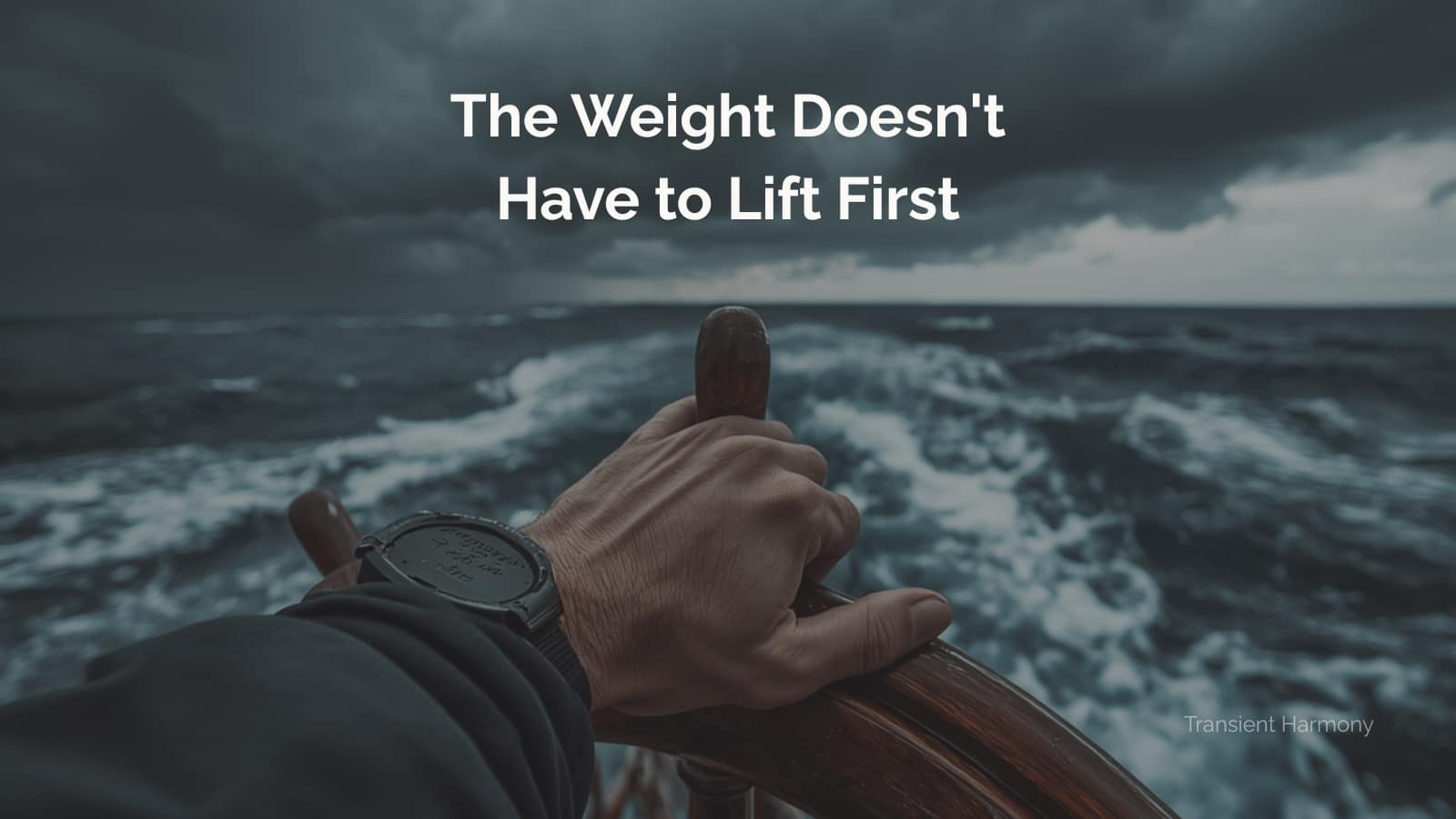
The challenges do not disappear. The difficult season does not end on cue. But something changes when we stop positioning ourselves as someone waiting for rescue and begin recognizing ourselves as the captain of this particular ship, in these particular waters, navigating terrain that on some level we chose.
That last part matters.
In Transient Harmony, the mortal life string — the resonant pattern of experience we move through in this lifetime — is not assigned to us. It is selected. Not in granular detail, not as a rigid script, but as a field of experience our soul recognized as its own. Which means the terrain is not foreign. It is ours. And there is a difference between carrying someone else’s weight and moving through your own.
When that recognition lands — even partially, even imperfectly — something in the self begins to realign.
This is where the multidimensional self becomes relevant. We are not one thing. We are physical, emotional, mental, and spiritual dimensions sounding together — or not quite together, when one layer is overwhelmed and the others are compensating. When the mental and emotional layers are bearing the full weight of a heavy season, the body follows. The mornings feel heavier. Motivation recedes. The rut deepens not because anything is wrong with us but because the self is fractured across its own dimensions, each one pulling in a slightly different direction.
The Four Pillars of Navigation exist precisely for this — not as a system to master but as orientations to return to. Touchstones. When the water is rough, they are less about philosophy and more about having something to put your hand on.
But before the pillars, before the practices, there is the switch.
The moment you stop asking when this will end and start asking what this terrain is asking of you — something shifts. Not dramatically. Not all at once. But the multidimensional self, no longer fracturing against the resistance of waiting, begins to move in the same direction again. The physical follows the emotional follows the mental follows something quieter and more durable underneath all of it.
The challenges remain. The waters are still the waters.
But now there is someone at the helm.
And waking up into that — even on a heavy morning, even in a season that hasn’t turned yet — is different from waking up into the waiting.
The weight doesn’t have to lift first.
You just have to pick up the wheel.