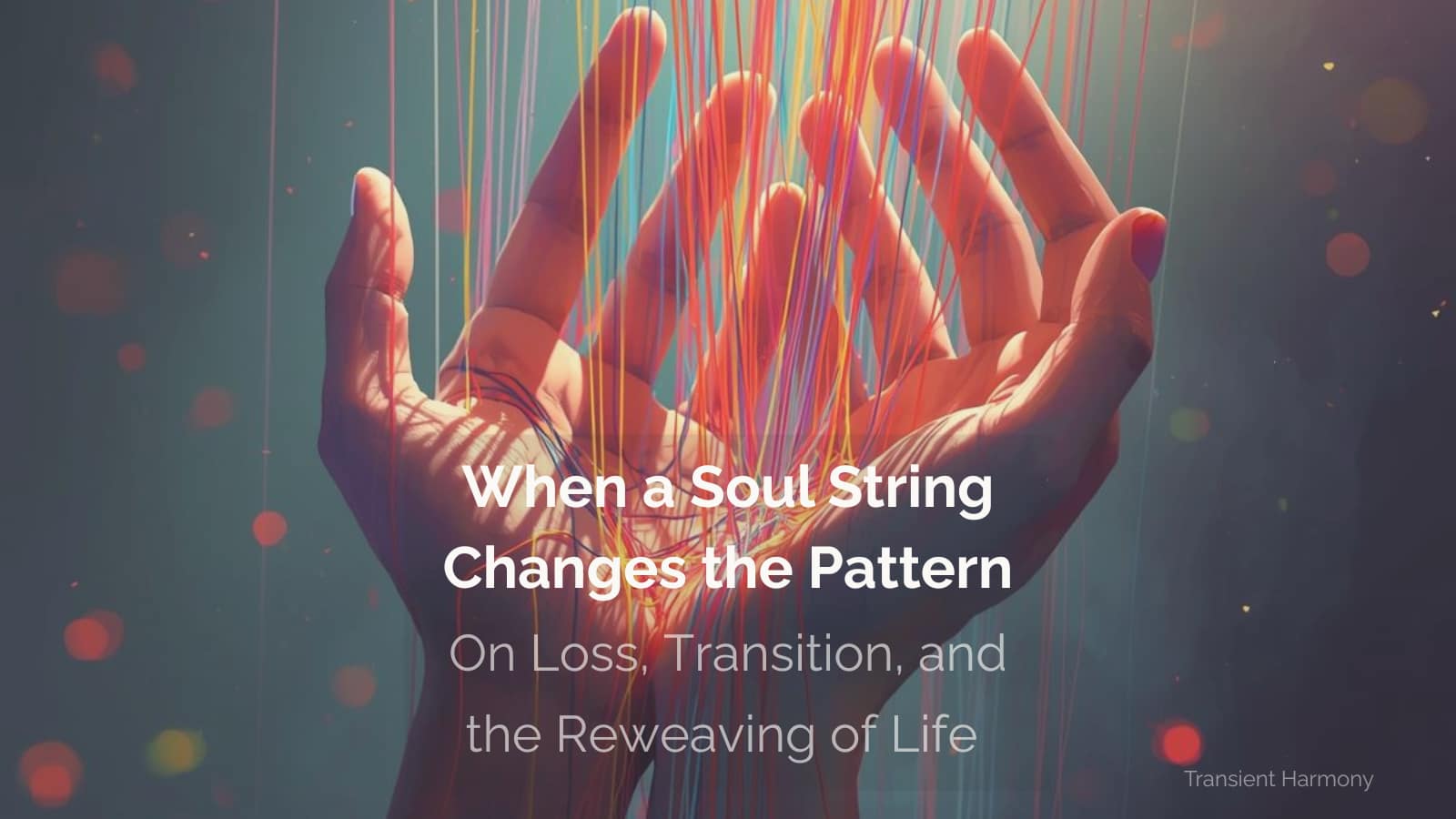
When a Soul String Changes the Pattern: On Loss, Transition, and the Reweaving of Life
By Braddon Damien White
There are certain transitions in life we know will come, yet we are never fully prepared to meet.
The loss of a father.
A brother.
A grandfather.
A father-in-law.
These are not small crossings along the path. They are thresholds that quietly divide our lives into before and after. Even when anticipated, even when surrounded by love and support, something in us feels the shift as permanent.
When someone we love passes, many say there is a hole left behind.
And emotionally, that language makes sense. Grief feels like absence. It feels like reaching for a familiar presence and finding only air. It feels like something that should still be here but is not.
But as I have sat with the passing of my father-in-law — a man whose soul string intertwined with mine for sixteen years — I have begun to see something slightly different.
Not a hole.
A reweaving.
In Transient Harmony, I describe each soul as carrying its own energetic signature — its own soul string. Our journeys in mortal life are not isolated threads moving through space. They intertwine. They cross, stretch, pull, and strengthen one another in ways we rarely notice while they are happening.
When two lives merge through marriage, friendship, or family, the weaving deepens. Over time, roles take shape — son and father, brother and brother, grandfather and grandchild, son-in-law and father-in-law. Shared holidays. Conversations. Disagreements. Laughter. Silence. Quiet understanding.
Years pass. Patterns form. We begin to assume the weave will continue as it has.
And then, one mortal life string completes.
It is tempting to say something has been removed. That there is now a space that must somehow be filled. But no one can be replaced. No relationship can be replicated exactly. A father is not substituted. A brother is not exchanged. A grandfather is not duplicated. A father-in-law is not replicated in form or function.
So perhaps grief is not about filling a hole.
Perhaps it is about learning how to live within a new pattern.
When one soul string completes its mortal arc, the weave of our lives shifts. The tension redistributes. The rhythm changes. The landscape of our relational world alters permanently. This is impermanence in its most personal form.
And yet, this change does not unravel us.
It transforms us.
There are transitions we only understand in hindsight. Years after losing a father, we see how it shaped our steadiness. Years after losing a brother, we see how it deepened our empathy. Years after losing a grandfather, we see how it softened how we hold our own children. Years after losing a father-in-law, we see how it reshaped our marriage, our priorities, our presence.
These losses do not leave us unchanged. They reconfigure us.
This does not mean we are grateful for the loss. It does not mean we bypass the ache. It does not mean we pretend the sorrow is not real. Grief is not weakness. It is the nervous system recalibrating to a new relational reality. For years, a certain soul string has been woven into our daily awareness — in expectation, in shared space, in subtle knowing. When that presence is no longer physically here, our body and heart must learn the new configuration.
That recalibration feels like sorrow.
But sorrow is evidence of love.
And love is never wasted.
The influence of a life does not disappear when the mortal string completes. It becomes integrated. It shapes how we move forward. It alters how we treat others. It deepens how we hold those still intertwined with us.
There is something powerful about shifting from the metaphor of a hole to the understanding of reweaving. A hole implies deficiency. Reweaving implies transformation. One keeps us longing for restoration. The other invites us into conscious movement.
We do not fill what is gone.
We learn how to live differently because it was here.
We allow the pattern of our own soul string to change shape — to stretch, to tighten, to soften in new places. We become someone slightly different on the other side of the threshold.
The passing of someone we love is not just an ending. It is a transition that continues through us. We honor a father by becoming steadier. We honor a brother by becoming braver. We honor a grandfather by becoming more patient. We honor a father-in-law by becoming more present in our own relationships.
Not because we “move on,” but because we move forward changed.
The soul string that once intertwined with ours in mortal life does not vanish into nothingness. It completes its earthly expression. And we carry forward the imprint of that weaving in the way we speak, the way we love, the way we show up.
In this way, grief becomes part of our growth.
Not a hole to fill.
A pattern transformed.
And as painful as that transformation can be, it is also sacred.