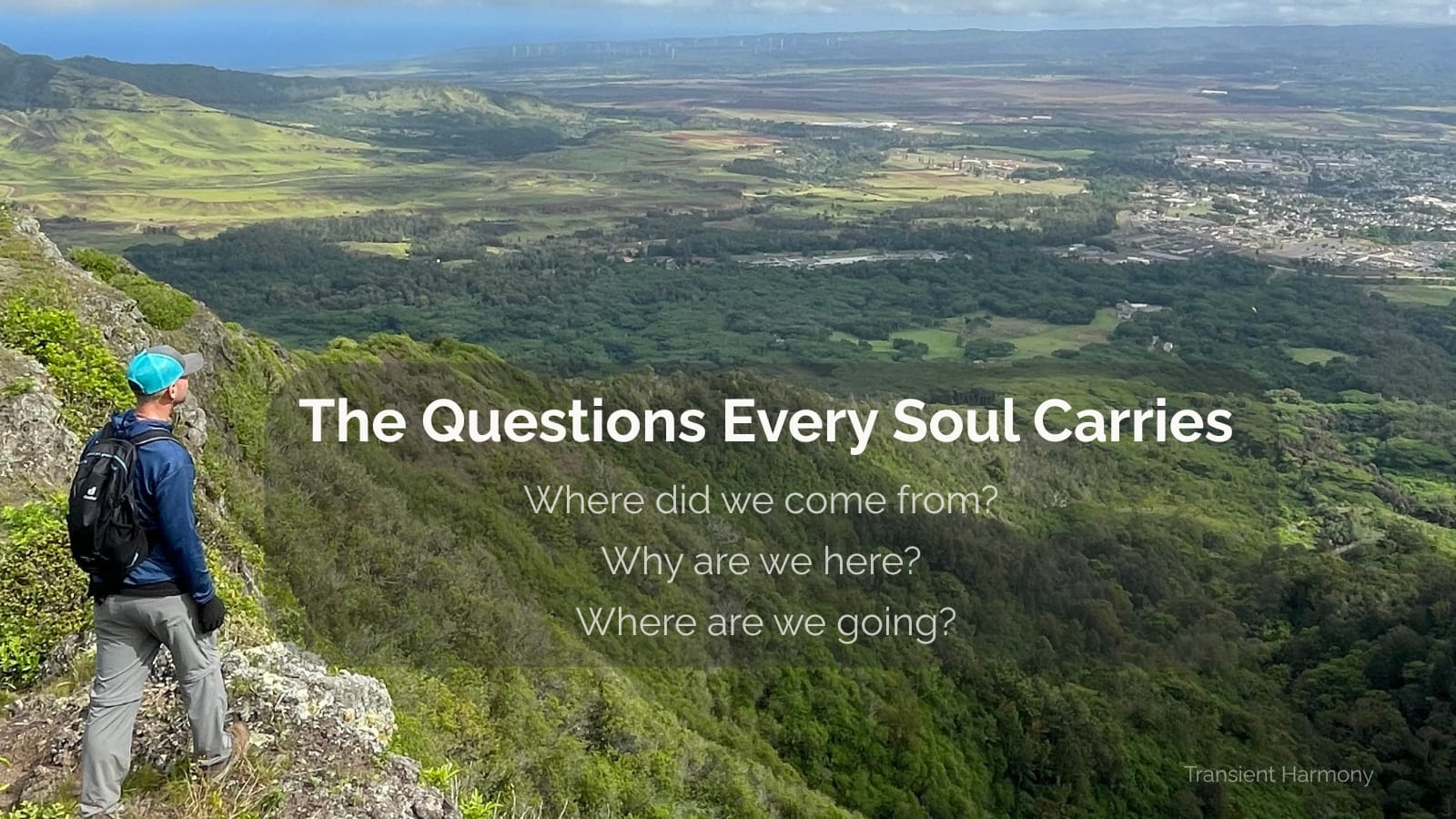
The Questions Every Soul Carries: Where did we come from? Why are we here? Where are we going?
By Braddon Damien White
There are three questions I have carried most of my life.
Where did we come from? Why are we here? Where are we going?
I first encountered them with answers already attached. Growing up within the LDS tradition, these weren’t open questions — they were settled ones. The framework I was handed as a child was coherent, complete, and confident. It knew where I came from, why I was here, and exactly where I was going. For a time, that was enough. Perhaps more than enough. There is genuine comfort in a framework that holds you before you are old enough to ask what’s holding you.
But frameworks, like all living things, can be outgrown.
When the tradition I was raised in no longer resonated — when I found myself standing outside it, not in anger but in honest recognition — I discovered something I hadn’t anticipated. The answers left with the framework. The questions stayed.
They always stay.
I have sat with these questions in the particular silence that follows grief. In the long nights that arrive after loss, when ordinary certainty falls away and what remains is just the bare fact of existence and the ache of not understanding it. In those moments I wasn’t reaching for philosophy. I was reaching for something solid to hold. And for a long time, I reached and found mostly open air.
What I have come to understand — slowly, and not without cost — is that the open air was not emptiness. It was space. Space that a too-certain answer had been occupying.
These three questions are not unique to me. They are not unique to any tradition, any century, any corner of the world. Every philosophical and spiritual framework humanity has ever constructed has been, at its deepest level, an attempt to respond to them. They surface in the oldest texts we have. They surface in children who haven’t yet learned to suppress them. They surface in the dying, in the grieving, in anyone who has stood before something vast and felt the smallness and the wonder of being alive.
They are, I have come to believe, not problems to be solved. They are the shape of being human.
And that changes everything about how we might hold them.
Here is the thing about being human: we are extraordinarily good at answering questions. It is one of our defining impulses. We encounter something unknown and we move toward resolution — gathering information, testing possibilities, closing the gap between what we don’t know and what we do. This works beautifully for an enormous range of questions. It is how we navigate, how we build, how we learn.
But we bring the same impulse to questions that were never built to yield that kind of answer. And when the definitive answer doesn’t come — when the question remains open no matter how hard we press — we tend to experience that as failure. Either the question is unanswerable and therefore meaningless, or we simply haven’t found the right framework yet. So we keep searching. Keep pressing. Keep demanding a resolution that never quite arrives.
What if that demand is itself the problem?
Not every question is asking to be resolved. Some questions are asking something different — asking to be held, lived within, oriented around. The difference matters enormously. A question that asks for resolution needs an answer. A question that asks for orientation needs a framework — a way of standing in relation to it that allows you to navigate, to act, to find meaning, without requiring the open door to close first.
Where did we come from, why are we here, where are we going — these are orientation questions. They have been carried by every human culture precisely because they don’t resolve. They deepen. Every tradition that has engaged them honestly has understood, at some level, that the goal was never to close them but to find a way of living faithfully inside them.
And here is what I find most clarifying: the incompleteness isn’t accidental. It is designed.
The Veil of Purposeful Forgetting — the narrowing of awareness that accompanies mortal life — doesn’t exist because the universe is withholding something we’re owed. It exists because full knowledge would collapse the very conditions that make lived experience real. If we arrived here with complete answers, discovery would become performance. Love would become obligation. Courage would become choreography. The not-knowing is what makes the living genuine.
So the limitations aren’t a problem to overcome. They are the architecture of meaning itself. We were never meant to have complete answers to these questions. We were meant to develop an orientation toward them — one honest enough to hold the mystery, grounded enough to navigate by, and alive enough to deepen as we do.
That is a very different thing from resignation. It is, I would say, a more demanding posture than certainty. Certainty lets you stop. Orientation asks you to keep going.
Transient Harmony does not offer certainty about these questions. I want to say that plainly, because I know how much we hunger for certainty — I have hungered for it myself. What it offers instead is orientation. A way of standing in relation to the questions that neither deflects them nor drowns in them.
My understanding of where we came from — the Celestial Realm, the soul’s origin in a field of unbound awareness — is real to me. It resonates at a level that goes deeper than belief. But that understanding is incomplete. It will always be incomplete. And I have made peace with that. Not as resignation — as recognition. The incompleteness is by design.
Why are we here? My orientation is that each soul carries a unique answer to that question, found not through doctrine but through the slow, honest work of inner attunement — learning to recognize what resonates, what calls, what feels like the thread of your own life rather than someone else’s. Purpose is not a destination you arrive at. It is a direction you keep orienting toward, imperfectly and faithfully, across the whole of a life.
And then the third question. Where are we going.
In Transient Harmony, this is where something quietly extraordinary opens up — because when I sit with this question honestly, I find that the first and third questions are not actually separate. They are the same question, asked from two different points along a single unbroken continuum.
We came from wholeness. We are returning to wholeness. And here is what I have come to understand most deeply: we never left it.
The celestial soul did not depart when we were born. It narrowed. The Veil of Purposeful Forgetting did not sever us from our origin — it filtered our awareness of it, drawing our full attention into this particular terrain, this particular life, this particular set of experiences that only these conditions could produce. The soul that walks through a mortal life is the same soul that originated in the Celestial Realm. Not a fragment of it. Not a copy. The same one — simply experienced through a narrower aperture.
Which means that when this mortal life ends, what happens is not departure. Not arrival somewhere new. The veil lifts. The filtering stops. The wholeness that was present all along becomes fully present again — now carrying within it everything this life made possible. The grief that was genuinely felt. The love that was freely chosen. The courage that was required because the outcome was uncertain. The texture of a life lived inside real limitation.
None of that dissolves. It reintegrates. It becomes part of what the soul carries forward — not as memory exactly, but as resonance. As depth that wasn’t there before. As experiential knowing that no amount of celestial understanding could have provided without the immersion of a mortal life.
Where we came from and where we are going are the same place. The only thing that changes is what we bring back with us.
These questions have traveled with humanity across every culture and century because they are not asking to be answered and set aside. They are asking to be carried — with honesty, with humility, with the willingness to let our relationship to them deepen as we do.
I recently gathered the Transient Harmony orientation to all three in one place — a quiet page on the site simply called The Questions Every Soul Carries. It is not a declaration. It is an offering. A way of saying: here is how this framework holds what cannot be fully held.
If you have been carrying these questions — in loss, in wonder, in the long silence after a framework falls away — you are not alone in that. You never were.
The questions are not a sign that something is missing.
They may be the most faithful thing about you.