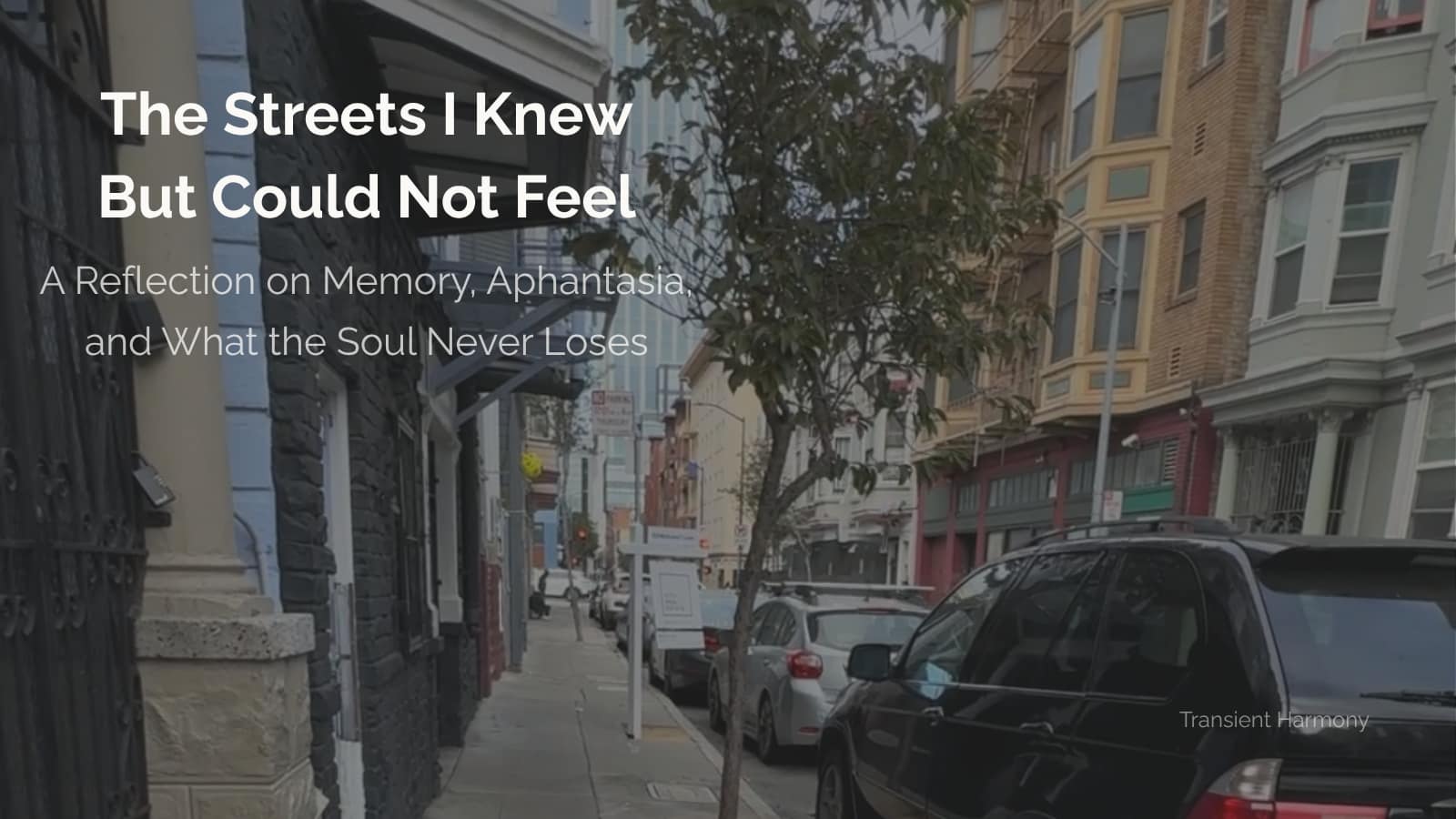
The Streets I Knew But Could Not Feel
A Reflection on Memory, Aphantasia, and What the Soul Never Loses
By Braddon Damien White
I walked my old neighborhood recently, back in San Francisco for a conference. Twenty years since I’d last been there. The Pickwick Hotel and its sign. The old Mint building. The street where I used to live, the loft above it. I recognized all of it, the way you recognize a route you can walk but could never recite. I couldn’t have told you what came next on the block before I turned the corner — but the moment I turned it, I knew exactly where I was.
And while I reminisced, I didn’t feel the sadness, the warmth, the nostalgia most people describe when they walk somewhere they used to live. I still reminisced — I wasn’t blank, wasn’t a stranger to my own history. I just wasn’t feeling my way back into any of it. I have full sensory aphantasia — not just an absence of mental pictures, but of any sensory imagery at all, layered with what looks like severely deficient autobiographical memory. So walking that street wasn’t a return to a memory. It was closer to reading a fact I already knew: this is the building where you worked for two years. True, certain, and completely without texture.
I want to sit in that gap for a moment, because it’s not a small thing. I worked in that building most days for two years. I have the knowledge of it the way I have knowledge of a date in history — solid, retrievable, mine — but I cannot feel having done it. No smell of the lobby. No sound of the street at five o’clock. No sense of what my body felt like walking that route, though I must have walked it hundreds of times. Somewhere along the way, without my consent, the entire experience became information. I know the sentence. I don’t have the paragraph it came from.
The same thing happens with smell, and it’s the clearest window I have into how this actually works. If I catch the smell of sawdust, I’m with my grandfather again — he worked wood in his garage often enough that the scent alone still carries him. Cut grass does something similar, some early edge of spring pushing up out of a dead winter. But I can’t summon either smell on my own. I can’t sit still and conjure sawdust into being the way someone else might close their eyes and be back in that garage. It only arrives when I meet it in real time — the actual smell, right now, in front of me. Then, and only then, the door opens. It isn’t an exception to the aphantasia. It’s the same limitation, just caught in the act — proof that the connection is still there, waiting on the one thing I can’t provide it myself: the real, present encounter.
I’d be lying if I said the rest of it doesn’t ever ache. There are smells I would give something to pull back on demand instead of by accident. Sounds I’d love to hear again exactly as they were, not remembered but present, the way they must have been the first time. Nights with my spouse I can describe in outline but can’t step back inside — I know we had them, I know what happened, and still I can’t return to the room. That longing is real, and I’m not interested in dressing it up as something it isn’t. This is a limitation. It sits in me as one.
But here’s what I don’t think it is: a loss at the level of the soul.
Nothing about what my mortal mind can’t retrieve implies that my Celestial Soul has lost anything. Every experience it has ever lived — in this mortal life string or any other, however many, however deep — remains fully its own, fully available to it, untouched by what happens to a hippocampus. What’s missing here is a feature of this particular instrument: this mind, in this body, wired without a replay function most people take for granted. And that instrument wasn’t handed to me by anything above or outside me — my soul knew this terrain when it chose this string, the same way it knew every terrain of every string it has ever walked. Not the specifics. Never the specifics. Those unfold only inside the walking. But the terrain itself, yes — known, and chosen anyway.
A mind that holds every scent and sound of a night twenty years ago, and mine — which holds none of it — aren’t different grades of soul. They’re just different terrains, different textures of mortal limitation, each asking something different of the soul moving through it. That’s precisely why no framework, including this one, can be handed to someone whole. Each of us has to look inward at the particular mind and body we were given and ask what this terrain, this specific limitation, is teaching us to do that we might not otherwise learn.
Here’s what mine has taught me, whether I would have chosen it or not: I have nowhere to retreat into. No well-lit room of the past to step back inside of when the present gets difficult or boring or ordinary. Whatever I have, I have now, because now is genuinely all I’ve ever been given unbroken access to. I’ve had to build my sense of presence out of necessity rather than discipline — Purposeful Discernment and Impermanence Appreciation weren’t practices I adopted so much as the only ground available to stand on.
I notice the friends I know with vivid, total recall sometimes fight the opposite problem — not absence, but undertow. A mind that can retrieve a moment in full color can just as easily get pulled backward into reliving it, or forward into a rehearsal of some imagined future built from a hundred remembered ones. Presence, for them, has to be chosen against a current. For me, there’s no current to choose against. Just the room I’m standing in — and, every so often, sawdust or fresh-cut grass, arriving uninvited to prove that nothing was ever actually lost, only waiting for its own door.
I don’t know that either of us has the better deal. I think we’ve each been given a different limitation to live with and through, and the living-through is the point — not the specific shape of what we were handed.
What has your own mind’s particular limitation been quietly teaching you to do, that you might not have learned any other way?