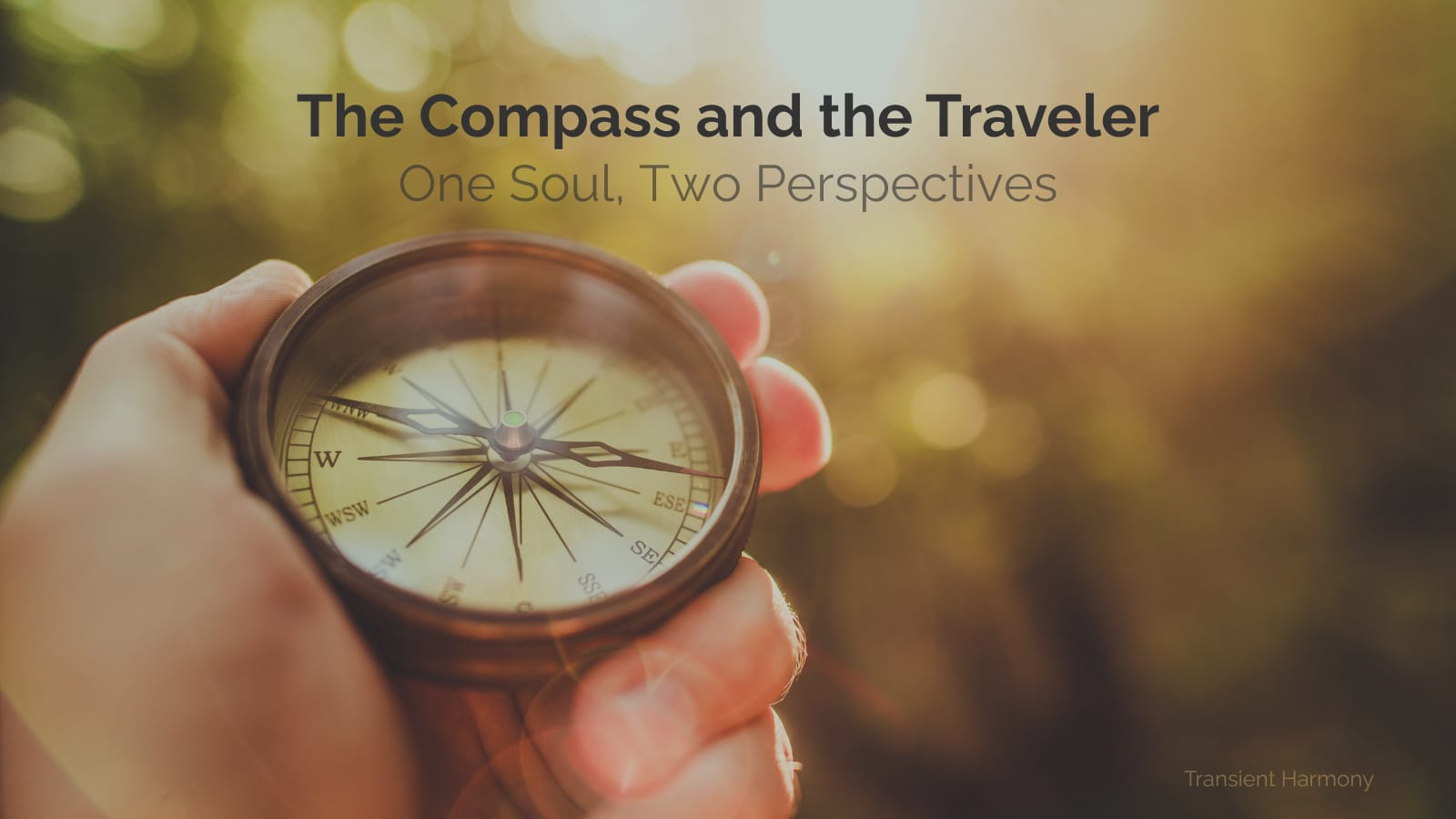
The Compass and the Traveler: One Soul, Two Perspectives
By Braddon Damien White
There is a subtle split many of us inherit in spiritual language.
We speak of a “higher self” guiding us.
We ask for direction from something wiser above us.
We imagine an inner voice that knows more, sees more, understands more.
Over time, this language creates a quiet separation.
There is me — the confused, embodied traveler.
And there is something else — elevated, overseeing, instructing.
But what if that split is unnecessary?
What if the guide and the one being guided are not two beings at all?
In Transient Harmony, the eternal self and the mortal self are not separate entities in conversation. They are the same celestial soul experienced through different constraints.
The difference is not identity.
It is perspective.
The eternal self is not “higher” in status. It is wider in view. Outside of time-bound sequencing, it perceives patterns as energy strings — landscapes of possibility rather than steps on a path. The mortal self, by contrast, walks within time. It experiences cause and effect, uncertainty and surprise, limitation and immediacy.
One sees the terrain.
The other feels the ground.
But both are the same traveler.
This is where the metaphor of the compass becomes useful.
A compass does not shout instructions.
It does not force movement.
It does not dictate which rock to step over or which valley to enter.
It simply orients.
It points north.
Intuition, in this framework, is not command. It is orientation. It is the subtle sense of alignment that arises when the mortal perspective momentarily resonates with its own wider awareness.
It does not say, “Turn left now.”
It says, “This direction carries coherence.”
The traveler still chooses the steps.
This distinction matters.
If we imagine the eternal self as issuing orders, responsibility begins to dissolve. We can blame fate. We can blame destiny. We can blame some higher orchestration for the choices we make.
But if the compass and the traveler are the same being, experienced from different vantage points, accountability remains intact.
The soul may choose the terrain — the general landscape of themes, capacities, and opportunities. But the mortal self chooses how to walk it.
Two individuals can stand on identical terrain and move in entirely different ways.
The compass may orient toward growth.
But growth is not forced.
The eternal perspective does not override free will. It simply widens context.
And perhaps this is why intuition feels different from impulse.
Impulse is urgent.
Intuition is steady.
Impulse pushes.
Intuition clarifies.
Impulse narrows awareness into reaction.
Intuition expands awareness into direction.
It does not remove uncertainty. It does not erase difficulty. It does not collapse the complexity of choice.
It simply points.
When we treat intuition as instruction, we subtly hand over authority. We imagine something above us determining our path. But when we understand intuition as orientation from another perspective of our own being, authority returns to where it has always belonged.
We are not being directed from above.
We are being oriented from within.
This continuity changes how we understand spiritual maturity.
It is not about surrendering to a higher power that overrides us. It is about integrating wider awareness without abandoning agency. It is about recognizing that the voice we sometimes call “higher” is simply ourselves unbound by immediate constraint.
The traveler does not become passive.
The traveler becomes aware.
And awareness does not remove responsibility — it refines it.
The soul may have selected a landscape rich with power, influence, creativity, or challenge. But how those capacities are expressed remains entirely within the hands of the embodied chooser.
The compass cannot walk.
The traveler cannot see the entire horizon.
Yet both are one.
When we stop splitting ourselves into guided and guide, something quiet settles. There is no cosmic hierarchy within us. There is only perspective.
We are not divided between earthly and heavenly versions of ourselves. We are a single celestial soul experiencing life through different lenses.
The eternal self does not command the mortal self.
It orients it.
And the mortal self, step by step, chooses how to respond.
We are not guided by something above us.
We are guided by ourselves from another perspective.
And that changes everything.