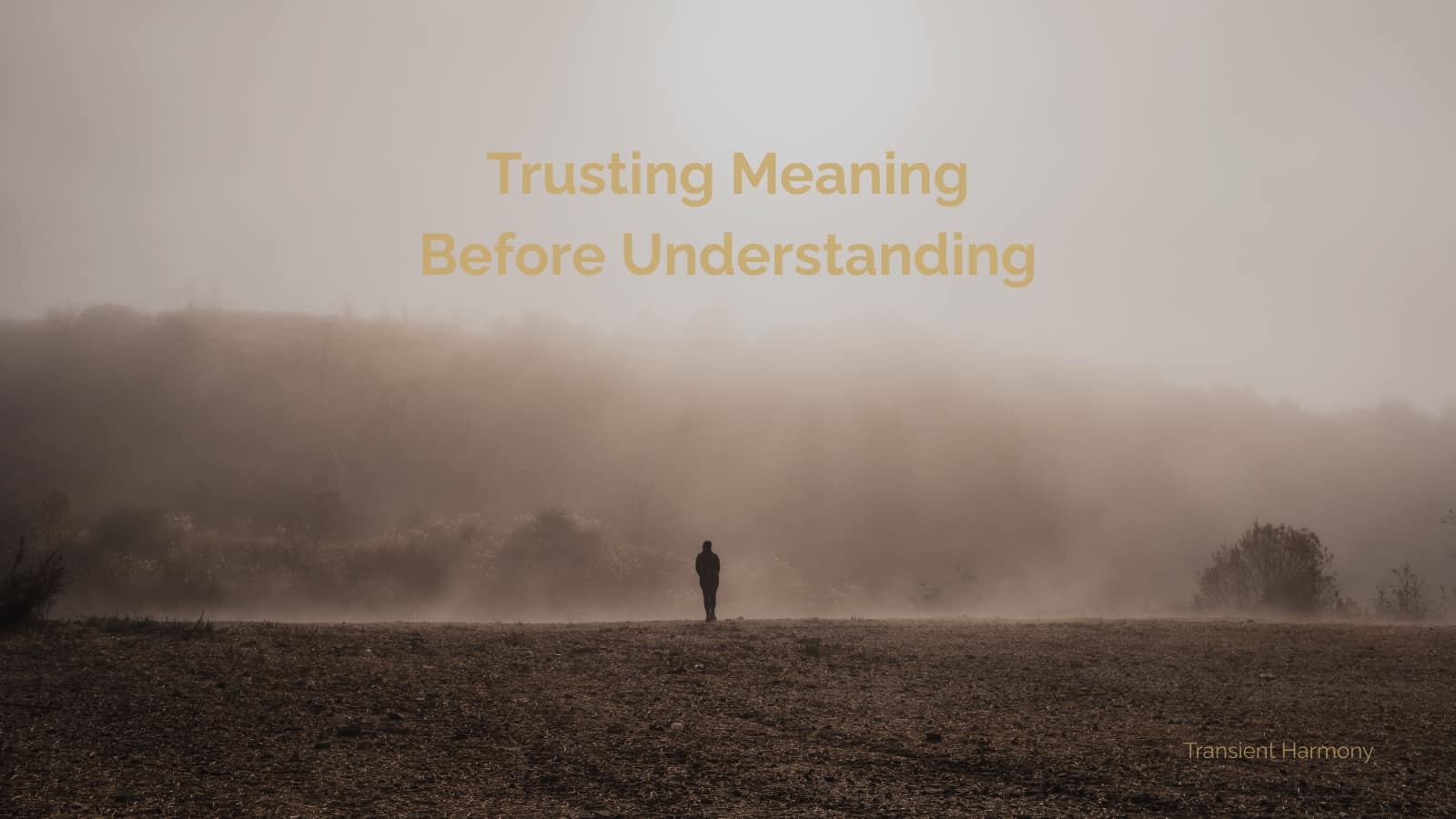
Trusting Meaning Before Understanding
By Braddon Damien White
There is a quiet question that lives beneath much of our anxiety, our striving, and our longing for clarity:
What would change if I trusted that my life is meaningful before I understand why?
So much of how we move through the world is shaped by the opposite assumption—that meaning must be discovered, proven, or earned. We are taught, often without realizing it, to believe that life will make sense once we arrive somewhere. Once we heal, succeed, awaken, resolve the tension, or finally understand what all of this is for.
Meaning, in this view, waits at the end of the journey.
Transient Harmony offers a different orientation. It suggests that meaning does not emerge after understanding, but exists prior to it—that meaning is not something we uncover once the questions are answered, but something we participate in while the questions are still alive.
What if your life is meaningful not because you can explain it, but because it was chosen?
Meaning Before Memory
Within the framework of Transient Harmony, the soul does not enter mortal life by accident. From the vantage of the celestial self, each mortal life string is selected—not as a rigid script, but as a resonance. A particular pattern of experiences, relationships, contrasts, and growth becomes compelling, not because it guarantees certainty, but because it offers depth.
And yet, upon entering mortal life, the soul passes through the veil of purposeful forgetting.
This forgetting is not a flaw. It is a condition. To fully experience discovery rather than recollection, sincerity rather than rehearsal, the soul must not remember why. Meaning cannot be pre-known without losing its power to transform.
Here is where the human tension arises. We sense, often faintly but persistently, that our lives matter. At the same time, we cannot access the reason directly. The mind searches for explanations, while the soul invites trust.
When Meaning Is Deferred
When we believe meaning must be understood first, life begins to feel like a problem to solve. Confusion feels like failure. Uncertainty feels like misalignment. Suffering feels like evidence that something has gone wrong.
We quietly ask ourselves: What am I missing? What am I supposed to be doing? Why doesn’t this make sense yet?
But what if the veil is not withholding meaning from us?
What if it is protecting meaning from being reduced to explanation?
In this light, forgetting is no longer cruel. It becomes what allows discovery to remain real. Not knowing is not a punishment—it is the very condition that keeps experience alive.
Trust as Orientation
To trust that your life is meaningful before you understand why is not blind faith. It is not the denial of doubt or pain. It is an orientation—a way of standing inside experience rather than hovering above it.
Meaning, then, is not retrieved. It is enacted.
When meaning is trusted rather than postponed, it quietly relocates. It no longer waits at the end of the journey, promised after clarity or arrival. It takes up residence in the middle of life—in motion, in incompletion, in becoming.
Life stops feeling like a test to pass and begins to feel like a conversation to participate in.
Living Inside the Veil
Much of our anxiety arises from the fear that if we do not figure life out quickly enough, we may be living the wrong one. But when meaning is no longer conditional on clarity, confusion softens. Not knowing becomes a valid state rather than a personal failure. The constant pressure to interpret, justify, and resolve begins to loosen its grip.
Pain does not disappear. Grief, struggle, and loss still move through us. But their context changes. Suffering is no longer proof of abandonment or error. It is not romanticized, nor dismissed. It is held as something that belongs—even before it makes sense.
This shift deepens compassion. For ourselves. For others. For all who are moving through life without answers.
From Narrating to Inhabiting
When meaning is deferred, we live as narrators of our own lives—constantly explaining what this says about us, where it is going, and how it will eventually resolve.
Trust allows presence to take the lead.
Moments stop being evaluated and start being received. Life feels less like a story we must manage and more like a melody we are already inside of—one we do not control, but can learn to move with.
In this way, the veil stops feeling like a punishment. Forgetting is no longer what hides meaning from us; it is what keeps meaning alive. It allows sincerity instead of performance, surprise instead of repetition. The veil does not obscure purpose—it protects it.
A Gentle Experiment in Trust
If this orientation feels difficult—or even abstract—you might approach it not as a belief to adopt, but as a posture to try on.
For one day, live as if your life is meaningful—without asking it to explain itself.
Move through the day without demanding reasons. Without requiring clarity. Without asking each moment to justify its place in your story.
Simply notice.
How you speak to yourself.
How you move through small moments.
How you relate to others.
What softens, what resists, what surprises you.
At the end of the day, ask—gently, without pressure:
What changed when I stopped demanding reasons?
No answers are required. No conclusions need to be drawn. This is not about evaluation, but awareness. About sensing what it feels like to inhabit a life that is trusted before it is understood.
Living as Though This Life Matters
Trusting meaning before understanding does not require believing that you were chosen in some grand or exceptional sense. It simply invites you to live as though this life is not accidental.
That quiet shift often brings greater care, attentiveness, and gentleness—especially toward the unfinished parts of yourself. Not because you must, but because it feels appropriate to treat a meaningful life with reverence.
The framework of Transient Harmony does not promise that you will remember your soul’s intentions. It offers something subtler and more enduring: a way to attune to your celestial self through resonance rather than recall.
Your soul does not ask you to remember why you chose this life.
It asks you to live it.
And perhaps, for now, that is enough.