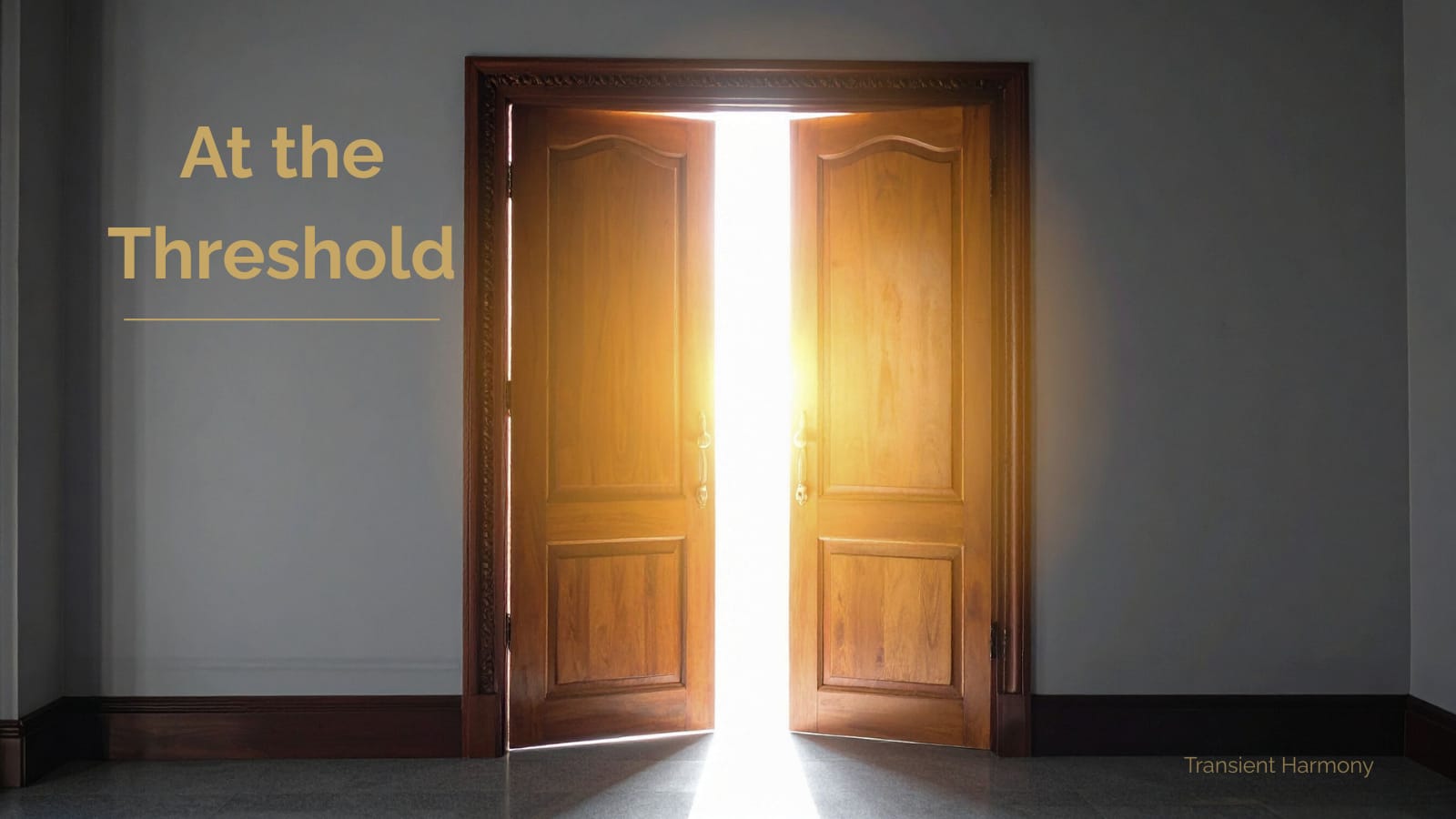
At the Threshold
There are moments in life that feel less like movement and more like standing still.
The turning of a year is one of them.
We have not yet crossed into what comes next, but we are no longer fully inside what has been. The old year loosens its grip, the new one has not yet asked anything of us, and for a brief moment we find ourselves in between. This space—quiet, often overlooked—is what I call a threshold.
A threshold is not the change itself.
It is the pause before change becomes motion.
In Transient Harmony, I speak often about the power of small pauses: a breath before speaking, a moment before stepping into a meeting, a stillness before responding instead of reacting. These moments are easy to dismiss because they seem insignificant. Yet they are often where clarity enters. A threshold does not demand action. It offers awareness.
Thresholds appear everywhere if we learn to notice them.
They show up in the morning, when the day has not yet taken shape.
They appear in the evening, when activity gives way to rest.
They exist before a phone call, before opening a door, before choosing a direction.
They surface in larger rhythms too—anniversaries, seasons, losses, beginnings, endings.
Not every threshold asks for the same response.
Some ask for silence. Others ask for expression. Still others ask to be witnessed in relationship.
The common thread is not how we pause, but that we do.
What makes a threshold powerful is not the ritual we place around it, but the attention we bring to it.
Some thresholds ask us to write.
When a moment carries complexity—conflicting emotions, unresolved questions, or the weight of accumulated experience—silence alone may not be enough. Journaling becomes a way of giving the soul a language. Not to analyze or fix, but to let what has been carried find shape on the page.
In Transient Harmony, reflection is not about arriving at answers. It is about creating enough space for truth to surface in its own time. Writing at a threshold can transform a vague inner tension into something we can meet with clarity and compassion.
Other thresholds ask for stillness.
A single breath. A pause before crossing into the next moment. A willingness to stop filling the space with noise. In these moments, nothing needs to be captured or explained. Presence itself becomes the practice.
And some thresholds are not meant to be crossed alone.
There are moments when presence deepens through connection—when speaking a transition aloud, sharing a reflection with someone we trust, or gathering with others to mark an ending or a beginning allows meaning to settle more fully. In these moments, resonance itself becomes the guide.
We often underestimate how much clarity emerges when a threshold is witnessed. Being seen—without advice, without correction—can steady us in ways solitude cannot.
In the book, I describe intuition not as something dramatic or mystical, but as a quiet signal that becomes easier to hear when we stop filling every space with motion. The eternal self—the deeper continuity of who we are—does not shout. It does not interrupt. It waits. Thresholds create the conditions where that waiting becomes perceptible.
Looking back on my own life, I can see how often things shifted not because I forced clarity, but because I paused long enough to sense it. At some thresholds, I listened—to the subtle pull of alignment, to the quiet resistance that signaled a misstep, to the gentle nudge that suggested patience rather than urgency. Those moments rarely felt dramatic at the time, but they shaped the path that followed.
At other thresholds, I rushed past. I filled the silence too quickly. I mistook motion for certainty. And in hindsight, those moments also taught me something—not as punishment, but as curriculum. They showed me what it feels like to move without attunement, and how that dissonance eventually asks to be corrected.
This is one of the core ideas beneath Transient Harmony: life is not a series of random events, but a pattern of opportunities to notice, to choose, and to integrate. Thresholds act like markers along that pattern. When we look back, we often don’t remember long stretches of continuity—we remember the doorways. The moments when something ended. The moments when something began. The moments when we paused just long enough to choose differently.
Thresholds also hold a quiet respect for impermanence.
They do not promise that what comes next will be easier.
They do not guarantee transformation.
They simply acknowledge that something is passing.
In this way, a threshold does not require readiness. It requires presence.
That is why the beginning of a new year can feel both heavy and hopeful. We are conditioned to treat it as a decision point—Who will I become? What will I fix? What will I change? But a threshold does not ask us to decide everything at once. It asks us to listen before we move.
In the practical sections of the book, I speak about practices for transitions—simple ways of marking moments so the soul has time to orient itself. Lighting a candle in memory. Reflecting at the end of a cycle. Gathering with others to name what is being released and what is being welcomed. These acts are not about control. They are about coherence—aligning our inner awareness with the outer movement of life.
As this new year opens, you don’t need a full map yet. You don’t need a perfected version of yourself waiting on the other side. You only need a moment at the threshold.
Take a breath.
And notice what this threshold is asking of you.
It may ask for quiet stillness.
It may ask for words on a page.
It may ask for connection—with a friend, a partner, a community, or a memory shared aloud.
There is no single right way to stand at a doorway—only the willingness to be present within it.
The next step will reveal itself when it’s time to cross.
And when it does, you won’t be starting from nothing. You’ll be carrying the awareness you gathered in the pause—the kind that helps you move forward not in haste, but in harmony.